

Repeated incidents are rarely caused by a single mistake — they reveal deeper system issues.
Barrier Failure Analysis (BFA) helps you uncover those weaknesses and understand why barriers failed.
This article is an educational primer that teaches you what BFA is and how to apply it.
What is Barrier Failure Analysis (BFA)?
Barrier Failure Analysis, or BFA, is a structured investigation method that identifies which controls failed, why they failed, and what system-level changes will prevent recurrence.
When a safety control fails, BFA helps you treat the issue as a system weakness rather than an individual fault. In practice, BFA asks three questions: what controls were expected, which were missing or failed, and why those protections did not work as intended.
This structure helps to identify system gaps and focus improvements on the barriers that matter most.
Why BFA matters
Most investigations stop at what went wrong. BFA teaches you to look for the reasons the defences failed.
When you focus on barriers, you shift recommendations from individual correction to system improvement.
Repeated incidents often look different but share the same weak points. Equipment faults, unclear procedures or supervision gaps can combine and defeat several controls at once.
If you only label events as human error, you miss the management or design issues that allow repeats. Use BFA to turn each investigation into learning that prevents the next incident.
Quick case
If the same safety valve fails after maintenance, list three questions:
- Is the valve design correct?
- Is the maintenance regime adequate?
- Was oversight effective?
Answering those questions makes the fix systemic rather than ad hoc.
Core idea: the causal layers

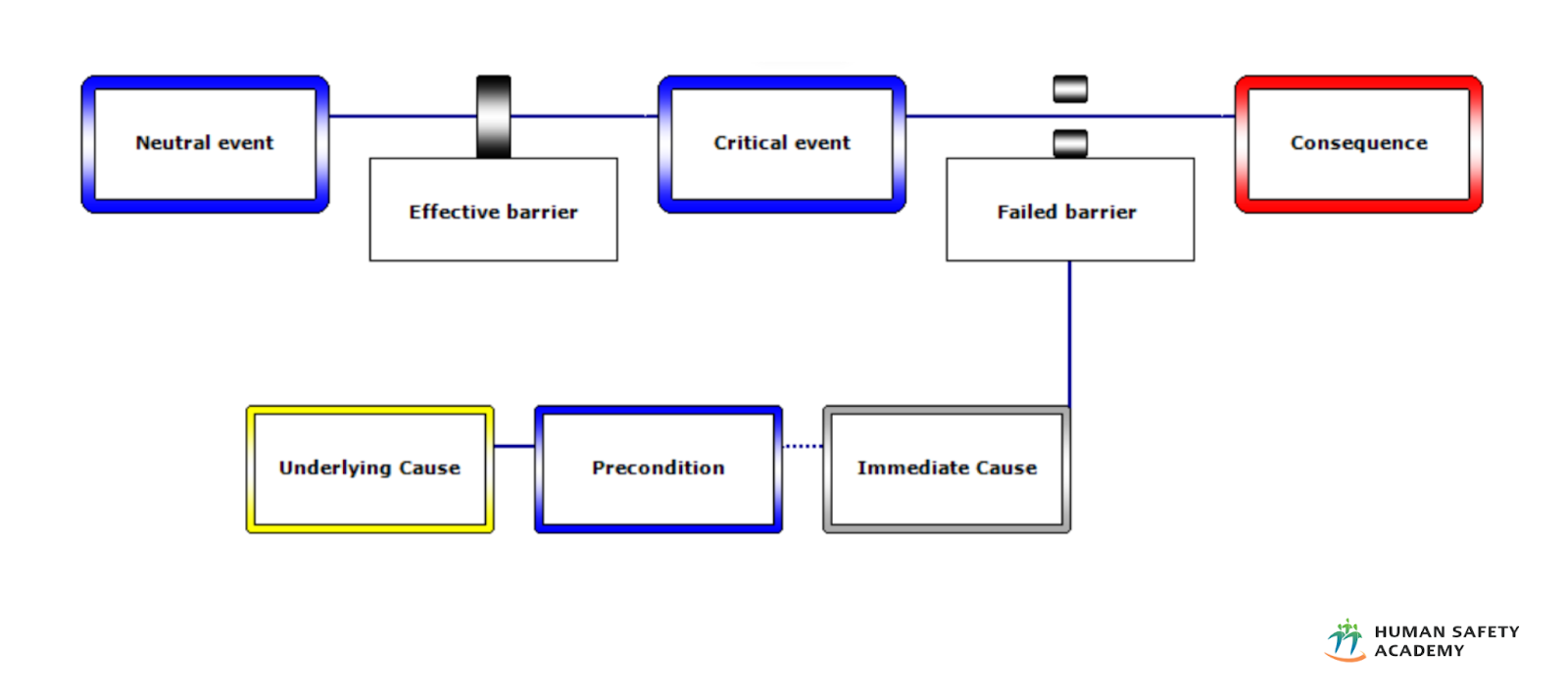
BFA explains causes using three causal layers: Immediate causes, Preconditions, and Underlying causes.
Each layer represents a different depth of analysis and helps you move from visible actions to the system factors behind them.
- Immediate causes are the visible actions or faults, such as a slip or an equipment malfunction.
- Preconditions are the local conditions that made the immediate cause likely, such as fatigue, poor ergonomics or unclear procedures.
- Underlying causes lie in management systems, design or culture and allow weak preconditions to persist.
Tracing causes to this underlying level shows where system changes can have a lasting effect.
Types of barriers (practical checklist)
Use these categories to classify barriers consistently during an investigation.
By function
- Preventive: stops an unwanted event from occurring.
- Mitigating: limits the severity of consequences if an event occurs.
By type
- Technical: sensors, guards and automatic cut-offs.
- Human or operational: procedures, checklists and training.
- Organisational: policies, supervision and resourcing.
Barrier status
- Failed: the barrier was present but did not work as intended.
- Effective: the barrier operated correctly and prevented escalation.
- Missing: the barrier was never implemented or formally identified, though it was expected.
- Inadequate: the barrier existed but was too weak or poorly designed to prevent the next event.
Models and frameworks
BFA links to familiar safety models that help you visualise and improve defences.
- Swiss Cheese: accidents occur when holes in several defence layers align.
- Tripod Beta: organises causes into Immediate, Preconditions, and Underlying levels and supports a consistent investigation structure.
- Bow Tie: visual links between threats, barriers and consequences; map BFA findings onto a Bow Tie to prioritise controls.
- STAMP/STPA and Root Cause Analysis (RCA): STAMP is a system-theoretic safety model, and STPA is the associated analytical method. RCA typically focuses on direct causes and may not always address systemic factors.
BFA complements these models by maintaining focus on barrier performance and system learning.
Where Barrier Failure Analysis is used
- In energy and oil & gas, a valve failure during shutdown revealed inadequate maintenance schedules and unclear handover procedures between day and night shifts. BFA traced the issue to design specifications that didn't account for actual operating conditions and gaps in regulatory compliance tracking.
- In rail and transport, a near-miss signal failure exposed outdated software protocols and insufficient testing after system upgrades. BFA showed the problem wasn't operator error but missing verification procedures and weak communication between technical teams and operations.
- In healthcare, a medication error traced back to look-alike packaging and alert fatigue from overloaded electronic systems. BFA revealed the issue wasn't individual negligence but inadequate prescription validation workflows and missing double-check protocols during high-pressure periods.
- In manufacturing, repeated equipment failures causing production losses pointed to reactive maintenance practices and missing performance monitoring. BFA identified gaps in preventive maintenance scheduling and unclear accountability for equipment inspections.
Different sectors, same logic: identify the barrier, trace why it failed through immediate causes, preconditions, and underlying causes, and strengthen the system.
Barrier Failure Analysis gives structure to learning across sectors and links technical, human and organisational performance so you see the whole picture rather than only the last visible error.
Conclusion and next step
Barrier Failure Analysis helps you treat incidents as system problems, not individual faults.
It gives structure to investigations and turns findings into improvements that reduce repeats.
BFA is applied internationally as an analytical method within safety investigations and training on risk management and incident analysis.
Human Safety Academy teaches BFA through interactive workshops, short practical exercises and post-course coaching so your team can apply the method to real incidents quickly.
If you want a rapid way to move from documenting events to preventing them, start with a BFA course and learn to map incidents, assess barrier health and prioritise fixes.